Why Is My Student Struggling to Read? 4 Hidden Reading Difficulties Revealed
Why is your student struggling to read? When you’ve tried everything and a child still can’t read, that’s where the Simple View of Reading comes in. Learn the two root causes of all reading difficulties and how they explain 4 different types of struggling readers. Use this post to figure out which type describes your struggling reader. Once you pinpoint WHY a student is stuck, you can give them exactly the help they need!
Welcome to the Be the Difference blog series: part 2!
Welcome back to the second post in the “Be the Difference” Reading Series! I am SO glad you’re here to continue this journey.
In Part 1, we learned the path that typically progressing children follow when learning reading. In an ideal world, all of our students would follow this path and succeed.
But, as we know, that doesn’t always happen perfectly.
We still get struggling readers who don’t make it all the way to the end. They often display some of these attributes that might sound very familiar:
- They shy away from decoding and instead, guess at words
- When they DO decode or sound words out, it is very labor intensive and hard for them
- There is no fluency — their reading is broken up and choppy
- They don’t comprehend what they are reading
Any of those sound familiar?
Here’s the good news: We can pinpoint the SOURCE of reading problems for these students using something called the Simple View of Reading.
🎬👇 {here’s a quick training video walking through everything in this post!}
Why Are Some Kids Struggling to Read? The Simple View of Reading
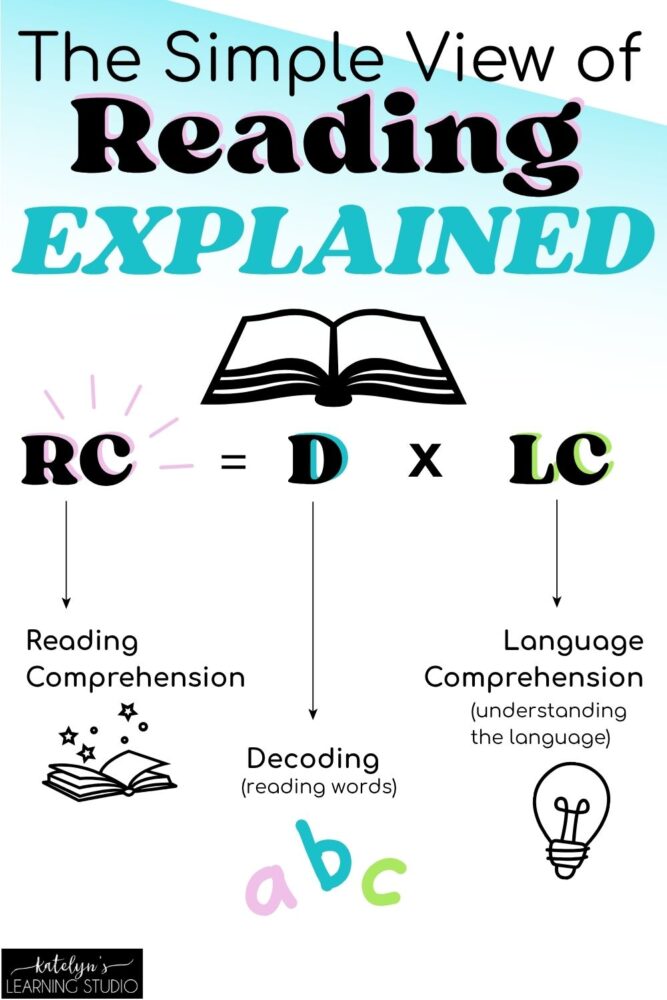
The Simple View of Reading breaks reading into two equally important parts: decoding and language comprehension.
📚 Definition: The Simple View of Reading is a formula developed by Philip Gough and William Tunmer (1986) that explains how reading comprehension is gained. Despite being decades old, it still stands today because it is the foundation of The Science of Reading.
The Simple View of Reading suggests that the WHOLE purpose of why we read is to gain meaning. Reading comprehension is the goal.
To get there, we need 2 things:
1. Decoding — the ability to match letters to sounds, and then sounds to words. Basically, decoding is just being able to read the words.
2. Language Comprehension — an understanding of the meaning of words and language, without the text. This is speaking and listening — understanding language when you hear it.
So decoding is words only (text-based), and language comprehension is language only (speaking and listening).
You have to be able to read the words… AND you have to be able to understand the language that the words are telling you.
The Multiplication Factor
Here’s what I love about the Simple View of Reading: There’s a multiplication symbol between these two components.
Reading Comprehension = Decoding × Language Comprehension
Each component gets a score between 0 and 1 (0 is 0% proficient, 1 is 100% proficient).
This multiplication suggests that decoding and language comprehension build off each other. If either one is missing or at a “0,” then reading comprehension will be at a 0 too.
BOTH decoding AND language comprehension are needed for learning to read successfully.
🔑 Key Takeaway: The Simple View of Reading tells us there are 2 different possibilities for the source of learning difficulties in reading: decoding (word-reading) problems OR language comprehension problems. This is huge for knowing how to help!
Not all struggling readers struggle for the same reason! Learn which type fits your student.
The 4 Types of Struggling Readers
Based on the Simple View of Reading, we can identify 4 different types of struggling readers. Understanding which type your student is will help you target your intervention effectively.
Hyperlexic struggling readers can decode words easily, but do not understand the meaning of them.
Type #1: Hyperlexic Readers –> What If My Student Can Read the Words but Doesn’t Understand?
The first type involves purely language comprehension difficulties.
Students who can decode perfectly and read a passage beautifully, but then have NO idea what they just read, are what we call “hyperlexic.”
These students are a bit more rare, but they are still out there. They can read the words — they just can’t understand the meaning.
Dyslexic struggling readers struggle to decode words due to a phonological core deficit.
Type #2: Dyslexic Readers –> What If My Student Can’t Blend or Decode Words?
The next type of struggling reader is dyslexic.
Now, I say that term and some people immediately have ideas jump into their mind about what dyslexia is. But there have been a LOT of misconceptions about dyslexia.
Dyslexia is NOT seeing letters backwards or any type of visual problem.
In the simplest terms, dyslexic students struggle to read because they have trouble learning how to decode. They have completely normal, or often above average, intelligence and language skills.
They just have trouble connecting letters to sounds.
Dyslexia is WAY more common than people realize.
According to the Yale Center for Dyslexia and Creativity, and the International Dyslexia Association about 20% of the population struggles with dyslexia. And dyslexia can account for 80-90% of all reading difficulties.
Dyslexic tendencies are THE most common type of learning difficulty when it comes to reading.
Mixed type struggling readers have both word-reading and language comprehension struggles.
Type #3: Mixed Type Readers –> What If My Student Struggles to Sound Out Words AND Understand Them?
These students struggle with reading on BOTH fronts– word-level decoding AND language comprehension.
When working with mixed type students, it is best to treat the word-level reading problems first, because sometimes that’s just the gate needed to allow the language skills to grow.
Compensator struggling readers have hidden word-decoding difficulties that they cover with advanced language skills.
Type #4: Compensators –> What If My Student Struggles with Reading Comprehension but Does Great with Listening Comprehension?
The last category of struggling readers is the compensators — and these students are SO tricky because they often fall under the radar and slip through the cracks.
These are students who have remarkable language skills, but disguised reading comprehension and word-level reading struggles.
Their vocabulary and language skills are so strong that they can guess words and fill in the gaps while they are reading, even though they can’t read the words through decoding.
This type of reading requires a lot of brain power to guess and fill in the gaps, which doesn’t leave as much brain power for higher-level reading comprehension.
Their strong language skills make it SEEM as though they have average reading comprehension and word reading skills, when in reality, they are actually struggling to read.
Here’s the problem: These students often do fine in the lower grades, but as texts get harder and their peers grow faster, they will struggle with reading in the higher grades. It’s SO important to identify and help them early.
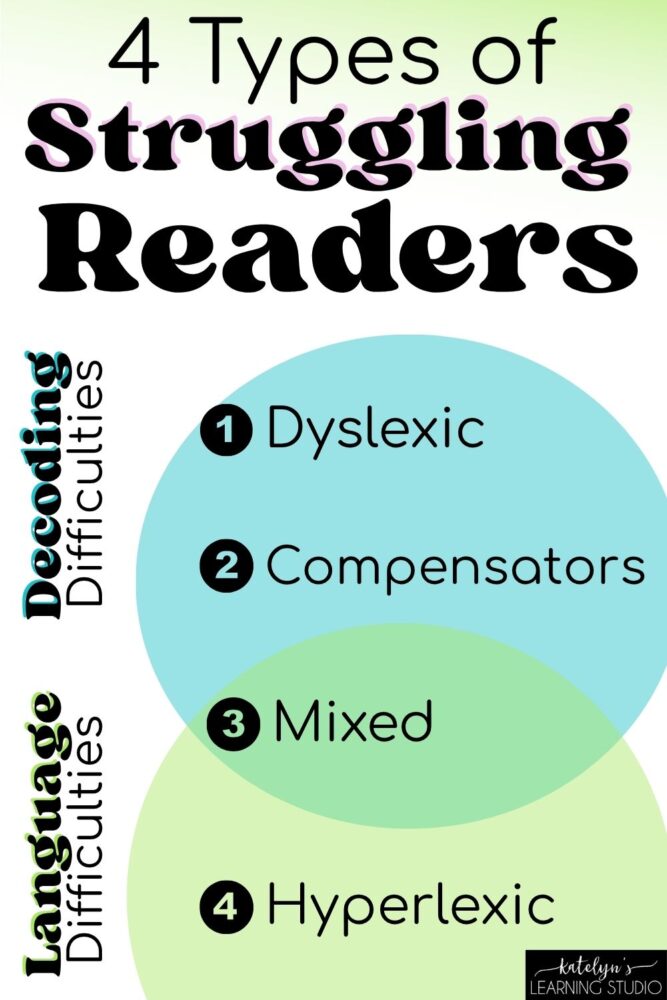
The 4 types of reading difficulties organized by root cause.
Struggling Reader Type Test: How Do I Find Out Why My Student is Struggling to Read?
Now that you know the different types of struggling readers, you’re ready to identify which reading difficulty type describes your student.
If you want in-depth help identifying exactly which type of reader you’re working with, my Comprehensive Reading Assessment tests both decoding AND comprehension skills to pinpoint exactly where students need support.
But for an initial estimate, here’s a QUICK test you can give your kiddos to give you immediate feedback on which areas they struggle with.
Simple Struggling Reader Type Assessment
- Read a passage out loud to them & ask them comprehension questions. Do they understand it?
- Have them read a passage out loud & ask them comprehension questions. Did they read it fluently? Do they understand it?
If your student is Hyperlexic…
- They would NOT understand the passage you read out loud
- They would read the passage themselves fluently
- But they would NOT understand the passage they read
If your student is Dyslexic…
- They would understand the passage you read out loud
- They would NOT read the passage themselves fluently
- They might understand the passage they read (but might not if they really struggled to decode)
If your student is Mixed…
- They would NOT understand the passage you read out loud
- They would NOT read the passage themselves fluently
- They would NOT understand the passage they read
If your student is a Compensator…
- They would understand the passage you read out loud
- They would read the passage themselves fluently
- But they would NOT understand the passage they read
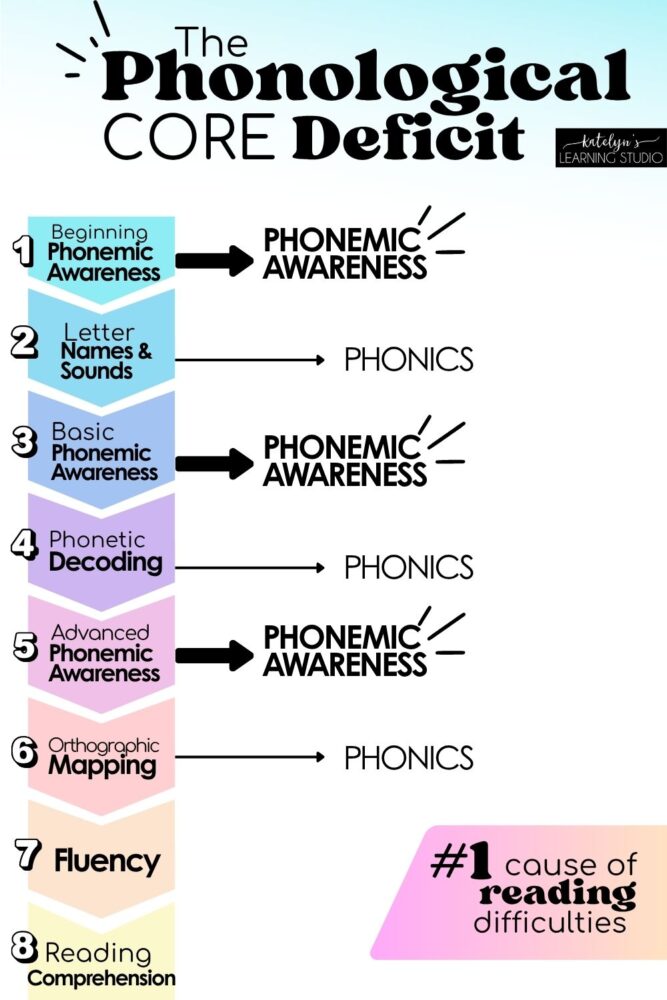
Notice the pattern: proficiency in phonemic awareness comes BEFORE each level of phonics.
What’s at the Root of the Problem? (The Phonological Core Deficit)
Now that we understand the different types of struggling readers, let’s look closer at what’s causing these learning difficulties.
Dyslexic readers are far more common than hyperlexic readers.
Most reading problems will be solved by fixing word-reading problems. Remember that reading progression path from Part 1?
Do you notice any patterns in how those skills develop?
I see: PA → phonics, PA → phonics, PA → phonics…
Each level of reading skills STARTS WITH PHONEMIC AWARENESS.
This phonemic awareness is the key to advancing to the next stage, and it is often where kids who struggle to read are getting hung up.
This is called the phonological core deficit — and it is ESSENTIAL to address.
That’s why I created my Phonological and Phonemic Awareness Binder — to systematically work through ALL the phonemic awareness skills in the right order, so students can build that strong foundation they need for learning reading successfully.
Why Can’t Some Kids Read Fluently? (Orthographic Mapping)
Remember that secret I told you about in Part 1 — orthographic mapping?
Most kids who struggle to read cannot make the jump to fluency BECAUSE they are not good at orthographic mapping.
So what’s needed to get good at orthographic mapping?
- Strong phonemic awareness skills — to hear the sounds in words
- Strong phonics skills — to map those sounds to the letters in words
You cannot orthographically map, or add words to your automatic sight word store, if you have a phonological core deficit or if you struggle with phonemic awareness.
This is why working on phonics intervention strategies isn’t enough on its own — you HAVE to address those underlying phonemic awareness gaps first!
Summary: Understanding Why Kids Are Struggling to Read
✅ The Simple View of Reading shows us reading difficulties come from either decoding OR language comprehension issues
✅ 4 types of struggling readers: Hyperlexic, Dyslexic, Mixed Type, and Compensators
✅ Dyslexic tendencies (decoding struggles) account for 80-90% of all learning difficulties in reading
✅ The phonological core deficit — weak phonemic awareness — is usually at the root of why kids can’t read
✅ Without strong phonemic awareness, students can’t orthographically map and build fluency
Ok, I know that was a lot of content and very heavy, but it is SO essential to get to the root of WHY our students struggle to read!
So now we know where we want students to be– to progress on the path of typically developing readers.
We know WHY they’re not there and what’s causing these reading struggles.
NOW, how do we bridge the gap to get them there?
We’ll answer that question in Part 3: How to Bridge the Gap! That’s where I give you the KEY to actually help your struggling readers. It’s where you take action to BE THE TEACHER THAT MAKES THE DIFFERENCE for students who struggle with reading.
📌Save for later! 4 Hidden Reading Difficulties That Keep Students Struggling to Read
Frequently Asked Questions
What percentage of students are struggling to read?
About 30% of students don’t naturally pick up reading and need explicit intervention. Of those struggling readers, 80-90% have difficulties with decoding (dyslexic tendencies) rather than language comprehension issues.
What is dyslexia really?
Dyslexia is NOT seeing letters backwards or a visual problem. It’s a learning difficulty with connecting language to print — specifically, struggling to decode words despite having normal or above-average intelligence and language skills. According to research, about 20% of the population has some degree of dyslexia.
Why do some students read fluently but not understand?
These are hyperlexic readers — they can decode words perfectly but struggle with language comprehension. While less common than decoding difficulties, these students need intervention focused on vocabulary, listening comprehension, and understanding language meaning.
Why can’t my student read despite trying everything?
When a child can’t read despite your best efforts, the root cause is usually a phonological core deficit — weak phonemic awareness skills. Without strong phonemic awareness, students struggle to read because they can’t connect sounds to letters effectively, which prevents orthographic mapping and fluency development.
If you need help figuring out exactly what YOUR struggling readers need, grab my FREE Reading Intervention Cheat Sheet. It helps you identify who needs help, pinpoint where they need it, and know exactly how to help them.
Understanding WHY your students struggle is the key to helping them succeed. You’ve got this!
Continue the “Be the Difference” Reading Series:
- Part 1: How Kids Learn to Read: 8 Steps to Reading Success
- Part 2: Why Is My Student Struggling to Read? (You are here!)
- Part 3: How to Bridge the Gap (coming soon!)