When learning reading becomes a struggle, how do you actually help students catch up? The answer comes down to using the right strategies, avoiding common mistakes, and acting quickly. The longer we wait, the bigger the gap becomes!
Welcome to the Be the Difference blog series: part 2!
Welcome to the final post in the “Be the Difference” Reading Series! I am SO glad you made it here.
If you have students struggling with reading (students who seem stuck, who guess at words, or who just can’t seem to catch up) this is the post where you’re going to learn how to actually BE the difference for them.

Quick recap of our journey:
In Part 1, we learned the path that typically developing readers follow to learn how to read.
In Part 2, we discovered WHY some readers fall off that path and get stuck.
And now, in this final post, we’re going to talk about what we can DO to get your struggling readers back on that path and headed toward success.
🎬👇 {here’s a quick training video walking through everything in this post!}
Before We Talk About What TO Do… Let’s Talk About What NOT to Do
Disclaimer: The following tips disrupt the flow of teaching as it’s been for decades.
Feathers might get ruffled… but it’s the truth! I’ll straight up tell you what works, and what doesn’t.
The following techniques still might work for SOME *typically developing* students.
But struggling readers need something different. And I’m here to help you find what actually works.
The 3 “Do NOT’s” When Students Are Learning Reading
Do Not #1: Don’t teach students to read like bad readers (guessing).
Do NOT #1: Don’t Teach Struggling Readers to Read Like Struggling Readers
Here’s what I mean by that: Teach struggling readers to read like GOOD readers.
One common teaching method is when students are reading and come across a word they don’t know, the teacher gives prompts like:
- Look at the picture and see if you can guess what the word is
- Look at the first sound in the word, and see if you can guess what the word is
- Think about what makes sense, and see if you can guess what the word is
- Skip the word and read the rest of the sentence, then go back and guess what that word might be
You can see a pattern here. There’s a LOT of guessing going on. A lot of relying on context. A lot of looking other places BESIDES the actual word.
These techniques are really tempting to use because they’re a “quick” fix. They let the student “read” that specific text and kinda say the right words.
But it’s really more of a band-aid approach. It does NOT address the root of the problem.
Those words that students are guessing will not be stored in their sight vocabulary just by guessing. In fact, most of the time when they guess, they’re not even looking at the whole word!
So the next time they come across that word, it won’t be in their store of sight words, and they’ll just have to guess again.
Guessing may be a short-term solution to get students to read a specific text, but it will NEVER get struggling readers caught up to their typically developing peers who are already reading so much and growing so fast.
What to Do Instead: Read Like Good Readers
The way to get students caught up is to get them to read like good readers — like those kids we’re trying to get them caught up to.
Typically developing readers follow the normal path. When they come across a word they don’t know, they use phonetic decoding to sound the word out. Then they recognize the word those sounds make and use orthographic mapping to connect the sounds in that word to the letters. (This is why word mapping activities are so powerful!)
They pay attention to the word.
So, we do NOT want to teach guessing. We want to teach paying attention to the word and sounding it out.
This can be a struggle for some students, but there are things you can practice with them that will give them the skills to make decoding easier. (Check out my 13 Phonics Intervention Strategies and these fun phonics activities for specific techniques!)
Do Not #2: Don’t rely on exposure & innate learning alone.
Do NOT #2: Don’t Rely on Exposure and Natural Learning
Another “do not” is to NOT rely on just exposure and having struggling students naturally learn how to read by themselves.
This approach can sometimes work for typical students, but it will NOT work for students who are struggling in reading.
Struggling readers need explicit instruction, and they need to be built up in those skills that will make them better readers. Multisensory learning activities are especially effective for these students.
Our instruction for students struggling with reading needs to be:
- Intentional
- Systematic
- Purposeful
This is exactly why the Science of Reading research is so important — it tells us what explicit, systematic instruction actually looks like.
Do Not #3: Don’t keep doing what isn’t working.
Do NOT #3: Don’t Keep Doing the Same Things That Aren’t Working
The last “do not” is to NOT keep doing the same thing over and over again if it’s not working for your student who is struggling with reading.
Something needs to change.
It’s not always the entire method that needs a complete overhaul, but there are many factors to look at.
When instruction isn’t working, consider changing:
- TIME — Your student might need more time, or more intervention. Or maybe they need shorter intervals of intervention sessions throughout the day so they don’t lose focus. (Try these Reading Activities for Intervention Mini-Lessons for short but effective lesson ideas!)
- INTENSITY — Cut out the fluff and get straight to business. Target exactly what skills they need the most help in and give them a lot of practice in it.
- STRATEGY — There are definitely more effective strategies out there than others, and you need to find what works best for your students. (Check out my 11 Reading Intervention Strategies That Work for proven approaches!)
Prevention vs. Intervention: Two Ways to Help Struggling Readers
Now I want to get into how to actually apply this in real life — and also stress the importance of getting these students the help they need as quickly as possible.
As explained by David Kilpatrick in his book Essentials of Assessing, Preventing, and Overcoming Reading Difficulties, there are two methods to help struggling readers:
- Prevention
- Intervention
Prevention: Building Skills BEFORE Learning Reading Begins
Prevention is for our pre-readers — preschool, kindergarten, and the first half of first grade.
The idea is to give students ALL the skills they will need to be good readers BEFORE everyone starts learning reading. Before their peers start to get ahead of them.
(Check out my tips for beginning readers for more on building these early skills!)
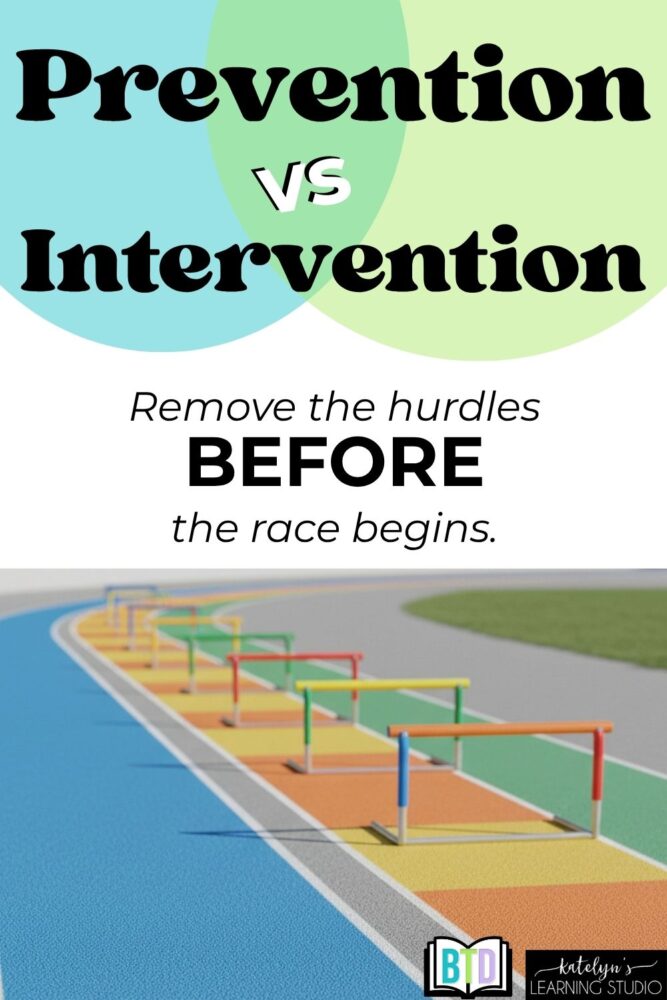
Prevention removes the hurdles before the race even starts.
The Hurdle Analogy:
In his book, Kilpatrick gives the analogy of a race. Imagine several kids lined up at the start of a race. Some kids have a normal, clear path to run. But a few kids have hurdles in their lanes.
You can imagine that the kids running with hurdles will be MUCH slower than the students running with clear lanes. As the race continues, the hurdle runners will fall further and further behind.
BUT — what if we removed those hurdles FROM THE VERY START OF THE RACE?
What if we took away those hurdles before they even started slowing down the racers? The students would be on much fairer racing ground, and they would all likely reach the finish line at a much closer time.
When we have effective prevention, we take away those hurdles.
This way, when reading typically develops (around mid-first grade), students will be so strong in the skills that make them good readers that they will develop right along with their typically developing peers.
This is essentially PREVENTING the gap from even forming in the first place. And this is ideal.
Building strong phonemic awareness skills early is one of the most powerful prevention strategies — it stops students from struggling in reading before they even start. My Phonological and Phonemic Awareness Binder covers all of these foundational skills systematically.
Intervention: Closing the Gap After It Forms
But we don’t always catch at-risk readers in time. Sometimes, we will need intervention.
Intervention takes place after reading starts being taught — usually around mid-first grade and on.
Intervention is:
- Identifying the students who are struggling with reading and falling behind
- And catching them up
Intervention means finding those students who are not growing in reading skills as fast as they should be, and helping them close the gap.
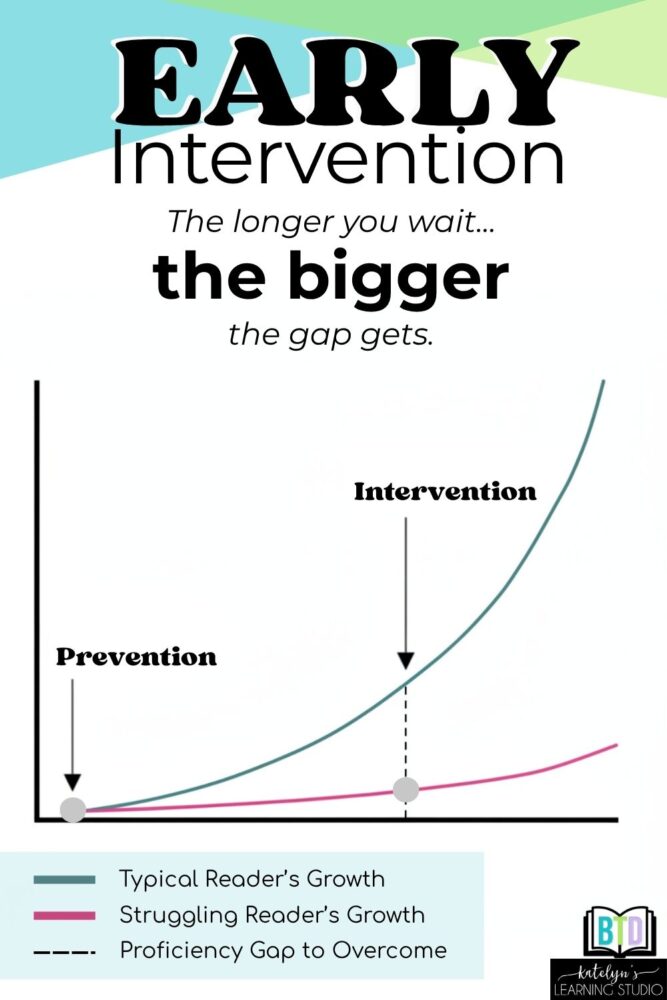
The longer you wait to intervene, the bigger the gap gets. Early intervention is key!
Understanding “The Gap” When Learning Reading
The time we switch from prevention to intervention is around the same time that the gap between proficient readers and struggling readers starts to form.
Typical readers:
Once typical readers start reading, they take off exponentially. The more they read, the better they get — and the better they get, the more they want to read.
So we have typically developing readers growing at a very rapid pace.
Struggling readers:
But then you have students who are struggling in reading, getting stuck at the very beginning. If they’re making any growth at all, it’s usually much slower, and so the gap gets bigger and bigger.
The longer this goes on, and the older kids are by the time we address this gap, the bigger it gets.
The more it feels like an impossible-to-cross chasm.
This is why prevention is so essential — to prevent that gap from even forming.
Even after the prevention period has passed, addressing reading problems QUICKLY can help minimize the distance you have to close between your struggling readers and proficient readers.
Bridge the Gap: Effective Strategies for Helping Struggling Readers Catch Up
Because time is so precious — and you don’t have a lot of it to waste on ineffective intervention — you MUST be using strategies that are going to make the biggest difference.
You must be targeting the right skills.
As a teacher, I know that time is precious to you. You don’t have a lot of it to waste. So you need your interventions to be as efficient as possible.
You want to use strategies that are going to have the biggest impact and target exactly the right skills that your students actually need.
Here’s the basic roadmap for learning reading success:
In most cases, you’ll want to start targeting word reading skills first.
You start with building phonemic awareness and phonics skills together, and then those will work together to help build fluency through orthographic mapping.
If students are having language comprehension struggles as well, you’ll want to focus on:
- Strengthening vocabulary
- Building and providing plenty of background knowledge
- Equipping students with comprehension strategies that will help them digest and understand what they’re reading better
This path focuses on what truly makes a difference in reading intervention.
Want a visual reminder? Download the FREE Bridge the Gap Reading Guide to keep this roadmap handy!
Click here to download your FREE Bridge the Gap Reading Guide!
📚 Ready to Put This Into Action?
If you’re feeling overwhelmed trying to piece together all of these skills and strategies on your own — or if you have students struggling with reading and need a clear path forward — I’ve got you covered.
My Reading Intervention Binders follow this EXACT path — building skills systematically from phonemic awareness through comprehension. Everything is organized, Science of Reading aligned, and ready to print and teach.
No more spending hours planning. No more wondering if you’re targeting the right skills. Just grab the binder, pull out the activities your students need, and watch them grow.
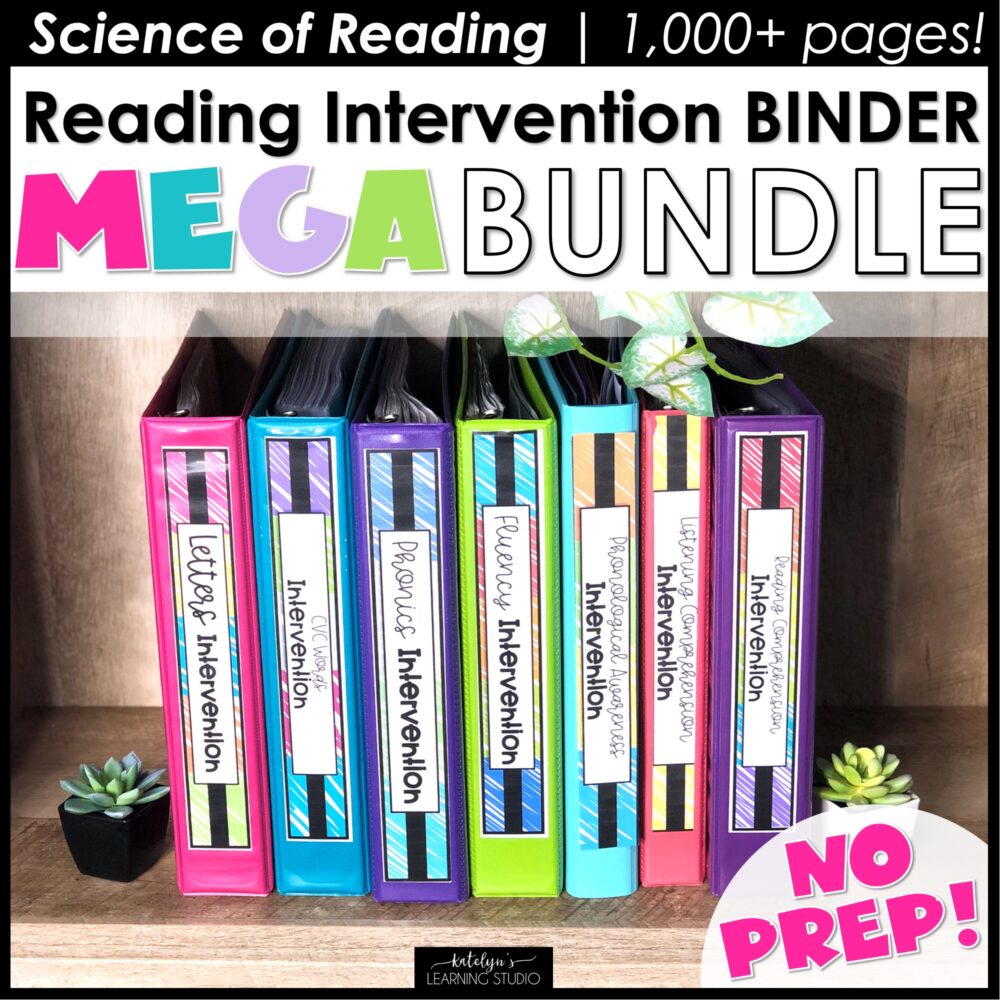
Everything you need for reading intervention in one place — check out the Reading Intervention Binder MEGA Bundle!
✨ What’s included:
- Systematic, explicit activities for every skill
- Games students actually LOVE (hello, engagement!)
- Built-in progress monitoring and data tracking
- Print-and-teach format — zero prep required
👉 Check out the Reading Intervention Binders here!
Summary: How to Help Students Who Are Learning Reading
✅ Don’t teach guessing — teach students to read like good readers do
✅ Don’t rely on exposure — use explicit and systematic instruction for learning reading
✅ Don’t keep doing what isn’t working — change the time, intensity, or strategy
✅ Prevention is ideal — build skills BEFORE the gap forms
✅ Intervention must happen quickly — the longer you wait, the bigger the gap
✅ Target the right skills — start with word reading (phonemic awareness + phonics → fluency) and add comprehension supports as needed
You Can Be the Difference
Now you’ve completed all three posts in the “Be the Difference” Reading Series!
You understand HOW kids learn to read, WHY some kids struggle, and now WHAT you can do to help them.
If you have students struggling in reading, you now have the knowledge to make a real difference. These posts are just the tip of the iceberg. There is SO much more you can do if you want to truly be a difference-maker teacher.
If you need help figuring out exactly what your struggling readers need, grab this FREE Reading Intervention Cheat Sheet. It helps you identify who needs help, pinpoint where they’re struggling, and know exactly how to help them.
You can absolutely be the difference for your struggling readers. I believe in you!
Continue the “Be the Difference” Reading Series:
- Part 1: How Kids Learn to Read: The 8 Reading Steps
- Part 2: Why Learning to Read is Hard for Some Kids
- Part 3: How to Help Struggling Readers (You are here!)
📌Save for later! Learning Reading: What Actually Works for Struggling Readers