How to Help Students Who Guess When Reading (11 Strategies)
Students guessing at words? Learn 11 Science of Reading strategies to stop guessing and build strong decoding skills.
Are you watching your students guess at words instead of actually decoding them? They look at the first letter and the pictures, say words that “make sense” – but they’re not reading the words on the page. Are you exhausted from constantly redirecting? Does it feel like you’re saying “sound it out” a hundred times a day with no progress? Students guessing at words instead of decoding is one of the most frustrating behaviors to see in struggling readers – and you’re not alone if you’ve thought “Will they EVER stop guessing?”

Discover 11 proven strategies to stop students from guessing at words and build strong decoding skills
When students keep guessing at words, either they’ve been taught cueing strategies (like looking at pictures or using context), or they haven’t developed strong enough decoding skills. So instead of sounding out words, they take shortcuts and guess.
Here’s the deal: This behavior is incredibly common, incredibly frustrating, and thankfully, fixable. This guessing behavior can absolutely be unlearned and replaced with systematic decoding skills.
Today I’m sharing 11 Science of Reading strategies that will help you stop students from guessing at words and teach them to become confident decoders instead.
📚 Quick Answer: Why Students Guess at Words & How to Stop It
Students guess at words when they lack strong phonics skills or have been taught cueing strategies. Stop guessing by: immediately redirecting to print, removing picture cues, using decodable texts at their level, and building systematic phonics skills. The key is consistency – redirect every single time for 4-6 weeks minimum.

Why Students Guessing at Words Prevents Reading Growth
According to the National Reading Panel’s meta-analysis of 66 studies (2000), skilled reading requires accurate and automatic word recognition. When students guess at words instead of decoding them, they’re not building the orthographic mapping skills needed to turn words into sight words.
Here’s what happens: Every time a student successfully decodes a word by connecting phonemes to graphemes, their brain creates a mental representation of that word – the pronunciation, spelling, and meaning bonded together. Dr. David Kilpatrick’s research in Equipped for Reading Success (2016) shows that students need 4-14 successful decoding attempts before a word becomes automatic. But when students guess? They skip this crucial process. The guessing habit prevents students from developing fluent reading skills and keeps them stuck.
💡 Key Takeaway: Every time students guess, they miss the chance to build orthographic memory. Redirection isn’t mean – it’s essential for reading development!
Feeling Overwhelmed? Don’t worry – you don’t need to do all 11 strategies tomorrow. Start with #1, #3, and #5 this week. Add more as you see progress. This is totally doable!

1. Immediately Redirect the Guessing Behavior
The first step to stop students from guessing at words is to interrupt the habit immediately – every single time you see it.
Why this is crucial: Every time a student practices guessing without correction, they’re strengthening that neural pathway. Research on habit formation shows that consistency is everything. If you redirect sometimes but not others, students won’t internalize the new expectation. Your brain learns what it practices, so we need students practicing decoding, not guessing.
How to do it:
- Establish a consistent redirect phrase like “Let’s look at all the letters” or “Touch and say each sound.” Choose ONE phrase and stick with it so students know exactly what’s expected.
- Use a visual signal (like pointing to your eyes) that means “pause and look at the print.” This gives you a silent redirect option that doesn’t interrupt flow for other students.
- Be consistent across all reading contexts – small group, independent reading, partner reading, everywhere. Students need to know the expectation never changes.
- Keep your tone encouraging but firm: “I noticed you guessed. Let’s try again and look at every sound.” Never shame, but never let it slide either.
- Make it immediate. Don’t wait until the end of the sentence. Stop them the moment you hear a guess and redirect right then.

2. Model the Difference Between Guessing and Decoding
Sometimes students don’t realize what they’re doing wrong. Making the contrast explicit and dramatic helps them understand what you’re asking them to change.
Why this works: Students often don’t have a clear mental model of what “good reading” looks like versus what they’re doing. Explicitly showing both approaches side-by-side gives them a reference point. Plus, making it theatrical and a bit funny takes the shame out of it – you’re showing them that EVERYONE can fall into bad habits, and good readers make conscious choices.
How to do it:
- Choose a simple sentence from a decodable text like “The cat sat on the red mat.”
- First, demonstrate guessing: Look at pictures, skip words, say words that “make sense” without checking all letters. Be dramatic! Say things like “Hmm, I see a cat in the picture, so this word must be ‘kitty’!” even when the word is “cat.” Or “This word starts with M… I’ll just say ‘monkey’!” without looking at the other letters. Make silly mistakes on purpose.
- Then demonstrate proper decoding: “Now watch me be a REAL reader. I’m going to look at every single letter. C makes /c/. A makes /ă/. T makes /t/. Let me blend: /c/ /ă/ /t/… cat! See how I checked every letter? That’s what real readers do – we look at ALL the letters, not just the first one.”
- Ask students: “Which way was better? Why? What did I do differently the second time?” Let them articulate the difference in their own words. This solidifies their understanding.
- Refer back when you see them guessing: “Remember when we compared guessing and decoding? Which one are you doing right now?” This gentle reminder helps them self-monitor.
I literally acted out being a “guessing reader.” My first graders thought it was hilarious when I dramatically looked at the picture and ignored all the letters. Then I would act out being a “sounder reader” and sound out the letters. Having them see both approaches made the abstract concept of “decoding” concrete and memorable.
[IMAGE: Split comparison graphic – left side shows student looking at picture with X, right side shows finger under letters with checkmark]
3. Remove Pictures and Visual Cues Temporarily
Pictures can become a crutch for students avoiding the hard work of decoding. Temporarily removing this support forces them to rely on print.
Why this works: When pictures are visible, students with guessing habits will automatically use them as their primary strategy. It’s easier and faster than decoding, so their brain defaults to the shortcut. By covering pictures, you eliminate the easy option and make decoding the ONLY option. Think of it like removing training wheels – it feels scary at first, but it’s necessary for building the real skill.
How to do it:
- Cover pictures with sticky notes when students are reading. This is quick, easy, and non-destructive if you’re using books.
- Have them decode the sentence or page first, then reveal pictures to confirm meaning. This teaches them that pictures are for checking comprehension, not for figuring out words.
- Use decodable texts with minimal pictures during intervention sessions. Many true decodable texts have very simple illustrations for this exact reason.
- Gradually reintroduce pictures once decoding becomes automatic and you’ve seen consistent success for 2-3 weeks. Then monitor carefully to ensure they’re not slipping back into old habits.
- Explain why you’re doing this so students don’t feel punished: “Pictures are wonderful, but right now they’re making it too easy to guess. I’m covering them for a little while so your brain can get really strong at reading the letters. Once you’re a super strong decoder, we’ll uncover them again!”
This might feel counterintuitive since we’ve been told pictures support readers. And they do! But for students with an established guessing habit, pictures are enabling the wrong behavior temporarily. Once they’ve broken the habit and built solid decoding skills, pictures can return to their proper role: supporting comprehension and engagement, not replacing decoding.
4. Build Strong Phonics Skills to Stop Guessing Behavior
Often students guess at words because decoding genuinely feels too hard or too slow. They haven’t mastered phonics patterns well enough to make decoding efficient, so their brain seeks shortcuts.
Why this works: If a student lacks the foundational phonics skills to decode a word, guessing isn’t really a choice – it’s their only option. You can redirect all day, but if they don’t know that “ai” makes the long A sound, they literally cannot decode “rain.” This is why building solid phonics skills is non-negotiable. Once decoding feels successful and efficient, the motivation to guess disappears.
How to do it:
- Assess which phonics patterns they’ve truly mastered versus which are shaky. Don’t assume they know something just because it was “taught” – test it explicitly with nonsense words to ensure they truly understand the pattern, not just memorized specific words.
- Provide explicit, systematic instruction in the patterns they’re missing. Use the “I do, we do, you do” model. Model the pattern multiple times, practice together with immediate feedback, then release to independent practice only when they’re ready.
- If they’re guessing at long vowel words, back up and teach those patterns in isolation first. Don’t try to fix guessing behavior while simultaneously introducing new phonics content. Master the pattern in isolation, THEN apply it to connected text.
- Practice patterns in multiple contexts: Start with word lists (isolated practice), then phrases (“the rain came”), then sentences, and finally connected text. Each step builds automaticity.
- Don’t move on too quickly. Students need 80-90% accuracy with a pattern in isolation before applying it to text. If they’re still struggling with “ai” in word lists, they’ll definitely guess when they see it in a sentence.
Pro Tip: If students can’t decode 85% of words in a text, it’s too hard. Back up to their instructional level!
I use this Phonics Intervention Binder to systematically teach phonics patterns with engaging games and built-in assessments, so I know exactly what students need and when they’re ready to move forward.
5. Use Decodable Texts at Their Instructional Level
Students need texts where they can successfully decode 85-90% of the words. When texts are too hard, they resort to guessing because they don’t have the skills to actually read the page.
Why this is non-negotiable: Imagine trying to read a page where you can’t decode half the words. What would you do? You’d guess! You’d use pictures, skip words, and try to make sense of it however you could. This is exactly what struggling readers experience when we give them texts above their skill level. We’re essentially forcing them to guess by giving them material they can’t actually decode. Appropriately leveled decodable texts remove this problem – students CAN decode the words, so they don’t need to guess.
How to do it:
- Choose truly decodable texts that use only phonics patterns students have been explicitly taught. Check the word list – if the book includes patterns they haven’t learned, they’ll be forced to guess those words.
- Check that students can decode 85-90 words out of every 100. Have them read a sample page before committing to the book. If they can’t decode at least 85%, it’s too hard right now. Find something easier.
- Gradually increase complexity as students master new patterns. Once they’ve mastered CVC words, add books with digraphs. Once digraphs are solid, add long vowel patterns. Always build on a solid foundation.
- Explain why the books might seem “easy.” Older students especially might resist “baby books.” Explain: “These books let you practice being a strong decoder. Once your decoding is automatic, we’ll move to harder books. Right now, we’re building your reading muscles.”
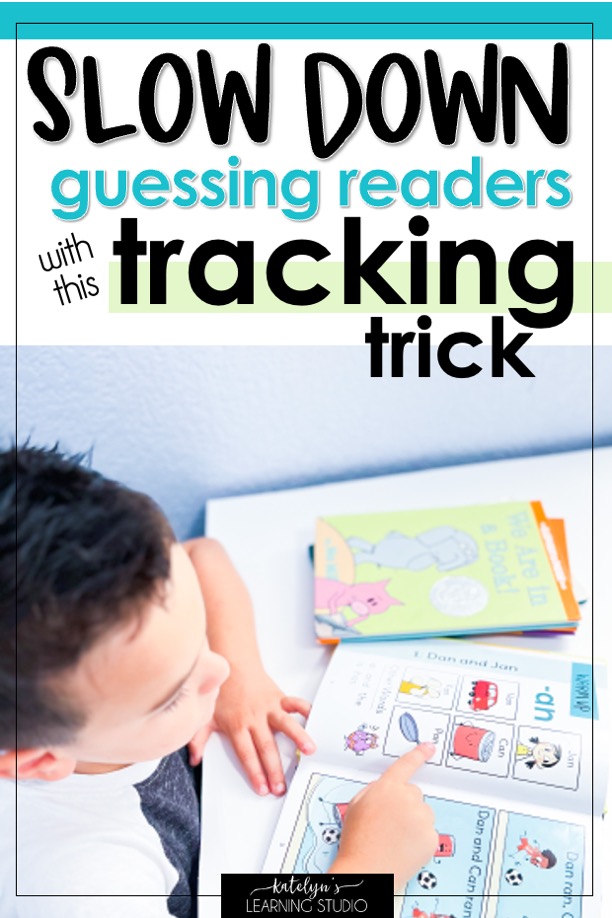
6. Slow Down with Physical Tracking
Finger pointing or tracking forces students to slow down and attend to each individual sound instead of letting their eyes jump ahead to guess.
Why this matters: Students who guess have often developed a habit of looking at just the first letter (or first and last letter) and then jumping to conclusions. Physical tracking breaks this habit by forcing them to process every single grapheme in sequence. It’s a temporary scaffold that retrains their eye movements and attention patterns.
How to do it:
- Have students physically touch under each letter or letter pattern as they say the sound. For single letters, touch once. For digraphs like “ch” or vowel teams like “ai,” touch once under the whole pattern while saying one sound.
- Explain it’s like training wheels – temporary but essential for building the skill. “We won’t do this forever, but right now your brain needs to slow down and look at every letter.”
- Use a tracking tool if fingers feel too childish for older students. A bookmark held under the line, a popsicle stick, or even a “special pointer” can feel more grown-up while serving the same function.
- Model it yourself first. Show them exactly how you touch under each letter and say the sound, then blend. Do this multiple times so they see the process clearly.
- Be patient with resistance. Some students hate finger tracking because it feels slow and babyish. Explain: “I know this feels slow. That’s the point. Right now, your brain is going so fast that it’s guessing instead of reading. We need to slow down so you can build the right habit.”
You’re making real progress if you’ve implemented even one of these strategies consistently! Keep going – you’re making a difference for your struggling readers.
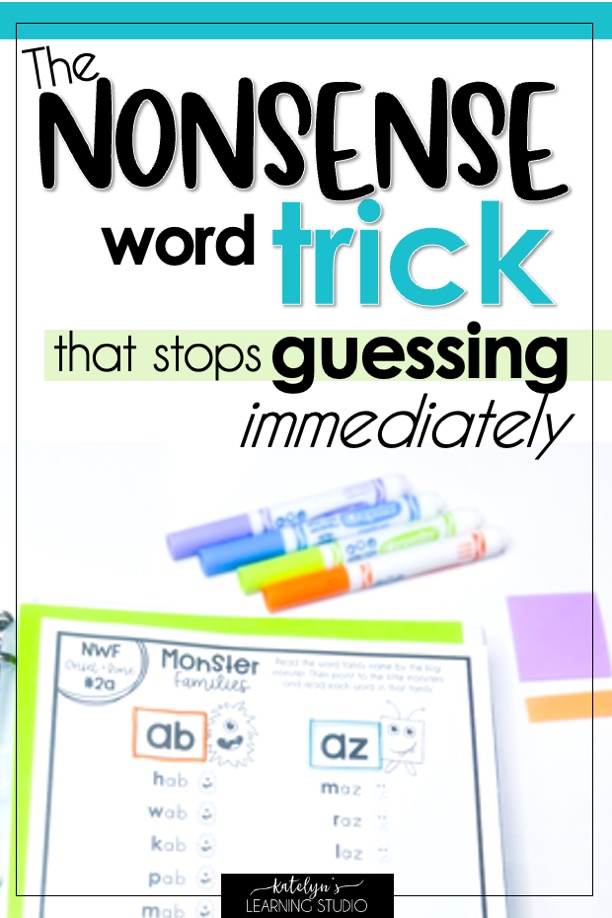
Use nonsense words (like in this Nonsense Word Fluency Binder) to keep students from guessing!
7. Practice with Nonsense Words
Students can’t guess nonsense words because they’re not real! This forces actual decoding instead of relying on memory, context, or vocabulary.
Why this is brilliant: Nonsense words are the ultimate test of true decoding ability. If a student can read “bim” and “fot,” you know for certain they’re actually decoding – they can’t possibly have memorized those words or used context clues because the words don’t exist. This is also excellent preparation for the real world, where students will constantly encounter unfamiliar words (especially academic vocabulary and technical terms) that they’ll need to decode.
How to do it:
- Start with simple nonsense CVC words like “bim,” “fot,” “pul,” “dak.” If students can’t decode these, they don’t have solid CVC skills yet.
- Mix nonsense words into regular word lists – for example: cat, bim, dog, fot, ran, pul. This prevents students from knowing which words to try to “remember” versus which to decode. They have to decode everything.
- Make it fun by calling them “alien words” or “silly words.” Create a story: “These are words from Planet Zorg! The aliens speak differently than we do!”
- Progress to longer nonsense words once simple ones are mastered: “bimfot,” “strunfed,” “blipsot.” These longer nonsense words mimic the multisyllabic academic words students will encounter in upper grades.
- Use nonsense words to test pattern mastery. When you teach a new phonics pattern (like “ai”), create nonsense words with it (“dain,” “brait,” “claip”) to ensure they truly understand the pattern, not just specific real words.
This Nonsense Word Fluency Intervention Binder is perfect for giving students that targeted decoding practice with no images or context to rely on!
8. Use Word Chains to Build Careful Attention to Sound Changes
Word chains force students to pay careful attention to each sound change because each word is only slightly different from the previous one.
Why this is so effective: Word chains make students slow down and notice precisely which sound changed, which develops phonemic awareness and reinforces that every single sound matters. They can’t guess because guessing wouldn’t make sense – the words are too similar. This activity trains students to be precise and careful, which is exactly what we need to break the guessing habit.
How to do it:
- Start with a simple word like “cat”
- Change one sound at a time: cat → bat (changed first sound) → bit (changed middle sound) → sit (changed first sound) → set (changed middle sound) → pet (changed first sound)
- Have students decode each new word, then explicitly ask: “Which sound changed? Which sound stayed the same?” This makes them consciously attend to the change.
- Use letter tiles or write the words so students can see the changes visually while also decoding them.
- Start with simple CVC chains, then progress to more complex patterns: snake → stake → shake → shake → shape, etc.
[IMAGE: Visual of word chain showing cat → bat → bit → sit → set → pet]
This takes just 5-10 minutes and is perfect for small group warm-ups!
Once you’ve addressed the behavior with strategies 1-8, you might discover the real issue is foundational skills. If students struggle with even simple word chains, they may need phonemic awareness support first.
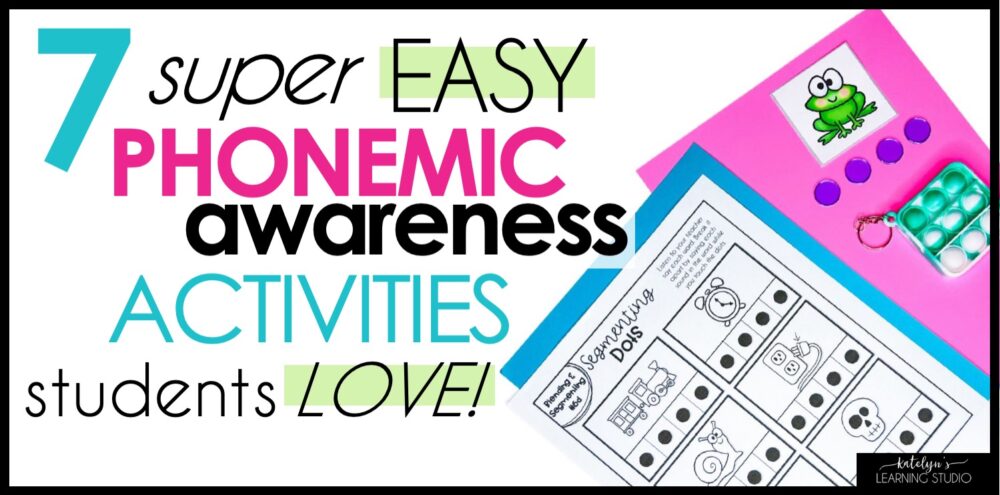
Phonemic awareness games that are super simple, and super fun!
9. Build Phonemic Awareness Without Print First
If students struggle with blending sounds together orally, they need phonemic awareness practice before the decoding issue can be fixed.
Why this is the foundation: Phonemic awareness (hearing and manipulating sounds in spoken words) is the foundation that phonics is built on. If a student can’t blend /c/ /a/ /t/ together to make “cat” WITHOUT looking at letters, they’re not going to be able to do it WITH letters. The phonics (connecting sounds to letters) can only work if the phonemic awareness (hearing and blending sounds) is solid first.
How to do it:
- Do oral blending games daily: Say sounds slowly (/c/ /a/ /t/) and students blend them to say “cat” – no letters involved. Start with 2 sounds (/a/ /t/ = “at”), then 3 sounds, then 4 sounds as they improve.
- Practice sound manipulation: “Say ‘cat.’ Now say ‘cat’ without the /c/.” (Students say “at”). Or “Say ‘run.’ Now say ‘run’ without the /n/.” (Students say “ruh”). This is harder than blending but crucial.
- Use sound boxes (Elkonin boxes) where students push counters into boxes as they segment sounds. For “cat,” they’d push 3 counters into 3 boxes, one for each sound.
- Practice sound substitution: “Say ‘cat.’ Now change the /c/ to /b/. What’s the new word?” This builds flexibility with sounds.
- Do this daily in short bursts – just 5-10 minutes per day is enough. Phonemic awareness work is intense, so keep sessions short and focused.
This Phonological Awareness Binder includes oral activities and games that systematically build strong foundations before introducing print, taking the guesswork out of what to practice.
10. Provide Consistent Corrective Feedback Every Time
How you respond when students guess incorrectly matters tremendously. Consistent, specific feedback helps students learn the right process.
Why consistency is everything: If you let guessing slide sometimes (“Oh, that’s close enough”), students learn that guessing is acceptable. If your correction routine varies (“Just sound it out” one time, “Look at the letters” another time, “What does that say?” another time), students don’t internalize a clear process. Consistency creates automaticity.
How to do it:
- Use the same correction routine every single time: “You said [their guess]. The word is [correct word]. Let’s decode it together. What’s the first sound? Good. What’s the next sound? Good. Now blend them: [correct word].”
- Have them reread the word correctly 3 times after you’ve helped them decode it. This creates a correct memory trace and begins to overwrite the incorrect guess.
- Go back and reread the entire sentence with the correct word. This reinforces reading for meaning and shows them how the correct word makes sense.
- Don’t just tell them the word. Always guide them through the decoding process so they practice the skill, not just hear the answer.
- Keep your tone neutral and helpful, not frustrated. Matter-of-fact correction (“Let’s try that again”) works better than exasperation.
11. Remove Time Pressure Completely During Intervention
Some students guess at words because they feel rushed to read quickly and think speed is the goal.
Why this matters: If students believe fast reading = good reading, they’ll take shortcuts (guessing) to achieve speed. We need to completely reframe what “good reading” means during intervention. Good reading is ACCURATE reading. Speed comes later, automatically, once accuracy is solid.
How to do it:
- Explicitly tell students at the start of every session: “Today we’re reading slowly and carefully. Speed doesn’t matter even a tiny bit. The only thing that matters is getting every sound right. Slow readers who get every word right are much better than fast readers who guess.”
- Never time students during intervention sessions. Save timed readings for progress monitoring only, not during instruction.
- Praise slow, accurate decoding enthusiastically: “I love how carefully you’re reading! You looked at every single sound! That’s exactly what good readers do.”
- Reframe their understanding: “Fast reading is what happens AFTER you become an accurate decoder. First we build accuracy. Speed is the bonus that comes later.”
- Model slow reading yourself. Show them that even skilled readers slow down for difficult words and that’s completely normal and good.
Remember: Slow, accurate decoding is what good readers do. Speed comes later!
Frequently Asked Questions About Students Guessing at Words
Q: Why do students guess at words instead of decoding? Students guess at words for two main reasons: (1) They’ve been taught cueing strategies that encourage guessing from pictures and context, or (2) Their phonics skills aren’t strong enough to make decoding feel efficient, so guessing feels easier and faster.
Q: What should I do if redirection doesn’t work after 6 weeks? If a student still consistently guesses after 6 weeks of consistent redirection, this may indicate a deeper phonological processing difficulty. Intensify phonemic awareness work (oral blending, segmenting) and consider additional screening for reading disabilities or processing disorders.
Q: Should I correct every single guess, even small ones? Yes. Consistency is crucial for breaking the habit. If you let some guesses slide because they’re “close enough,” students learn that guessing is sometimes acceptable. Every guess needs immediate redirection.
Breaking the Guessing Habit Takes Consistency
Breaking the habit of students guessing at words takes time and consistency. You won’t see change overnight, but you WILL see progress if you stay the course.
Redirect guessing behavior immediately, every single time. Pick your consistent phrase (“Let’s look at all the letters”) and commit to using it for 4-6 weeks minimum.
Then assess whether the issue is primarily behavioral (they CAN decode but WON’T) or skill-based (decoding is genuinely too hard):
If it’s behavioral: Focus on immediate redirection, removing pictures, modeling the difference, and removing time pressure.
If it’s skill-based: Focus on building phonics foundation, using appropriate decodable texts, and phonemic awareness practice.
Most students need both approaches!
Stop Students From Guessing at Words – You Can Do This!
Guessing at words is a learned behavior, which means it can be unlearned. With consistent redirection, explicit instruction, and the right practice materials, your students will absolutely develop strong decoding skills instead of guessing.
The key to stopping students from guessing at words is catching it immediately every time and redirecting them back to the print. Pair that with systematic phonics instruction at their level, and you’ll see real progress. Research from the National Reading Panel shows that systematic phonics instruction produces significant reading gains, with effect sizes of 0.41-0.44 for students with reading difficulties. Your consistent efforts matter and will make a lasting difference!
If you need help figuring out exactly what your struggling readers need, grab this FREE Reading Intervention Cheat Sheet. It helps you identify who needs help, where they need it, and how to help them – including breaking the habit of guessing at words.
You can absolutely be a rockstar reading teacher. You can be the teacher who helps students stop guessing at words and become confident decoders!
I believe in you!