Nonsense Word Fluency: 7 Activities to Build Decoding Skills in K-1
Master nonsense word fluency with 7 proven activities for K-1. Boost phonics skills and DIBELS scores with games, tips, and FREE challenge cards!
Nonsense word fluency is one of the most powerful ways to build true decoding skills in early readers. These 7 activities will transform your phonics instruction!
Picture this: Your kindergartener can breeze through their sight word list. They’ve memorized “the,” “and,” and “was” without breaking a sweat. But then you point to a simple CVC word they’ve never seen before—like “tob” or “pim”—and they completely freeze.
Sound familiar?
This little scenario happens all the time, and it reveals something critical about early reading development. When students can only read words they’ve memorized, they haven’t truly learned to decode. They’re missing that foundational skill that will help them tackle any word they encounter, whether it’s in a picture book or a chapter book years from now.
How do we build decoding skills?
That’s where nonsense word fluency comes in—and trust me, it’s not as silly as it sounds.
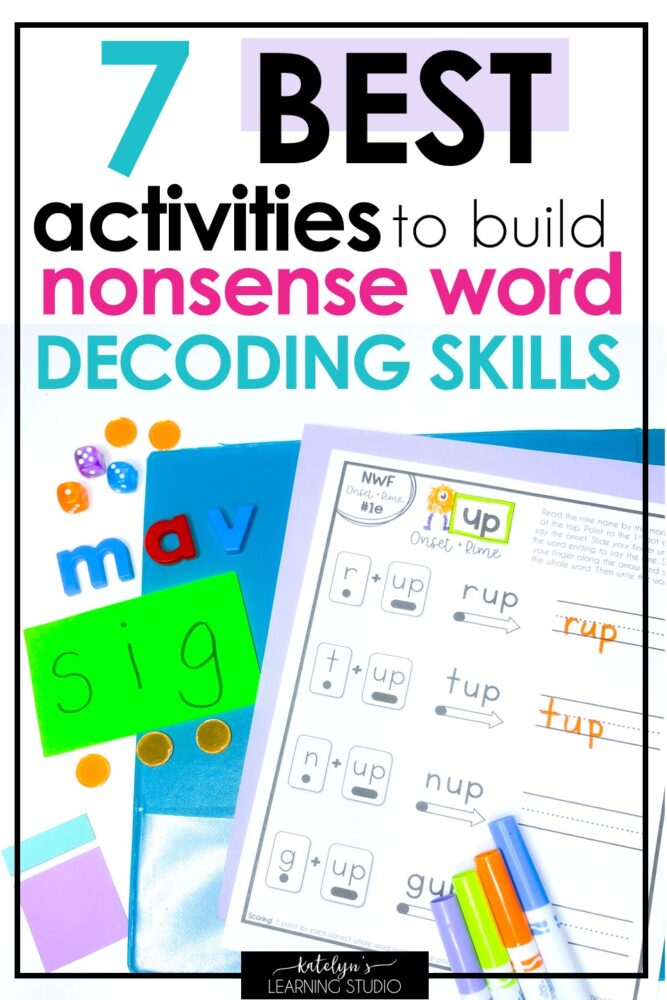
Ready to strengthen your students’ decoding foundation? These research-backed nonsense word activities work for whole group, small group, and intervention settings.
What Is Nonsense Word Fluency (And Why Should You Care)?
Nonsense word fluency (NWF) measures a student’s ability to decode made-up words that follow regular phonics patterns but don’t have real meanings. Words like “zat,” “plig,” or “doxing.”
Ok, I know what you’re thinking: “Why would I waste precious instructional time teaching kids to read fake words?”
Here’s the thing → nonsense word fluency is one of the most reliable predictors of future reading success. Research shows that a child’s ability to decode nonsense words in kindergarten and first grade directly correlates with their reading comprehension in later grades.
Why? Because nonsense words reveal pure phonics knowledge.
When students read nonsense words, they can’t rely on memorization or context clues. They have to use their phonics skills to sound out each letter, blend the sounds together, and read the word. It’s the ultimate test of whether they truly understand letter-sound relationships and can apply them flexibly.
The National Reading Panel identified phonics as one of the five essential components of reading instruction, and nonsense word fluency practice is a powerful way to reinforce those phonics skills in a controlled, systematic way.
The DIBELS Connection: Why Nonsense Word Fluency Matters
If you’ve administered DIBELS assessments (Dynamic Indicators of Basic Early Literacy Skills), you’re already familiar with the Nonsense Word Fluency subtest. DIBELS includes nonsense word fluency measures specifically because they’re such strong indicators of reading risk.
The DIBELS nonsense word fluency assessment asks students to read as many nonsense words as possible in one minute, measuring both accuracy and automaticity. Students who struggle with NWF often need additional phonics intervention—and the earlier we identify these students, the better.
Here’s what the research tells us:
- Students scoring below benchmark on DIBELS nonsense word fluency in kindergarten are at high risk for reading difficulties in later grades.
- Nonsense word fluency is a stronger predictor of future reading ability than real word reading in early grades.
- Regular practice improves both DIBELS scores and real-world decoding skills.
If you’re following the Science of Reading movement (and if you’re reading this, you probably are!), you already know that skilled reading requires strong phonological awareness, phonics knowledge, and automaticity. Nonsense word fluency hits all three, making it an essential component of your literacy instruction.
7 Research-Backed Activities for Teaching Nonsense Word Fluency
Now that you understand why nonsense word fluency matters, let’s talk about how to teach it effectively. These activities work beautifully whether you’re working with your whole class, a small intervention group, or one-on-one with a struggling reader.
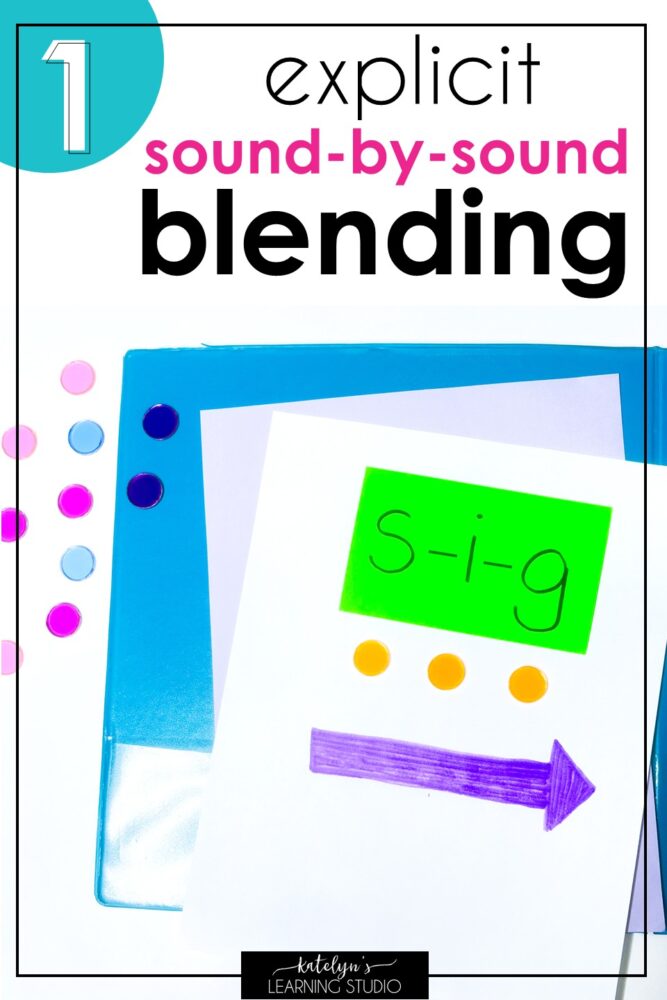
Start with explicit sound-by-sound blending using simple CVC nonsense words. This foundational skill is essential before moving to more complex patterns!
Activity 1: Explicit Sound-by-Sound Blending
Before students can achieve nonsense word fluency, they need to master the foundational skill of blending individual sounds.
Here’s how to scaffold this:
Step 1: Model the process aloud. Write a simple nonsense word like “sig” on the board. Point to each letter and say its sound: “/s/ /i/ /g/.”
Step 2: Blend the sounds together slowly, then at a normal pace: “Sssiiiggg… sig.”
Step 3: Have students practice with you, using the same word. Use hand motions or finger taps to represent each sound.
Step 4: Gradually release responsibility. Provide new nonsense words and have students blend with less support.
The key here is explicitness. Don’t assume students will figure out blending on their own. Model it, practice it together, and provide immediate corrective feedback.
This is especially important for beginning readers. If you have very beginning readers, make sure you check out these 5 Tips for Beginning Readers: The Best Ways to Grow Strong Reading Skills from the Start.
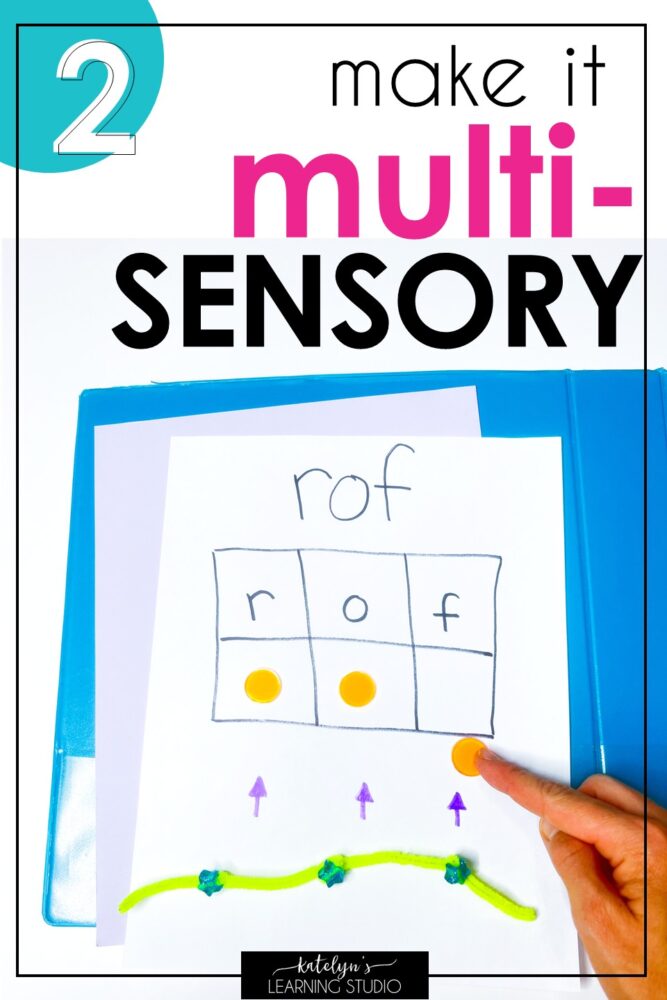
Multi-sensory approaches like Elkonin boxes help struggling readers connect sounds to symbols. This hands-on strategy builds nonsense word fluency while keeping students engaged.
Activity 2: Multi-Sensory Nonsense Word Practice
Struggling readers benefit tremendously from engaging multiple senses during phonics instruction. This is straight out of the Orton-Gillingham playbook, and it works.
Try these multi-sensory activities:
Sound boxes (Elkonin boxes): Students push a counter or chip into a box for each sound they hear, then write the corresponding letter
Skywriting: Have students “write” nonsense words in the air while saying each sound
Sand or salt trays: Students trace letters in sand while decoding nonsense words
Color-coding: Use different colors for vowels and consonants to help students identify patterns
These approaches help cement the connection between sounds and symbols in students’ brains, making decoding feel more concrete and less abstract.
For more multisensory activity ideas, here’s a post with 6 Fun Multisensory Learning Activities to Supercharge your Reading Instruction.
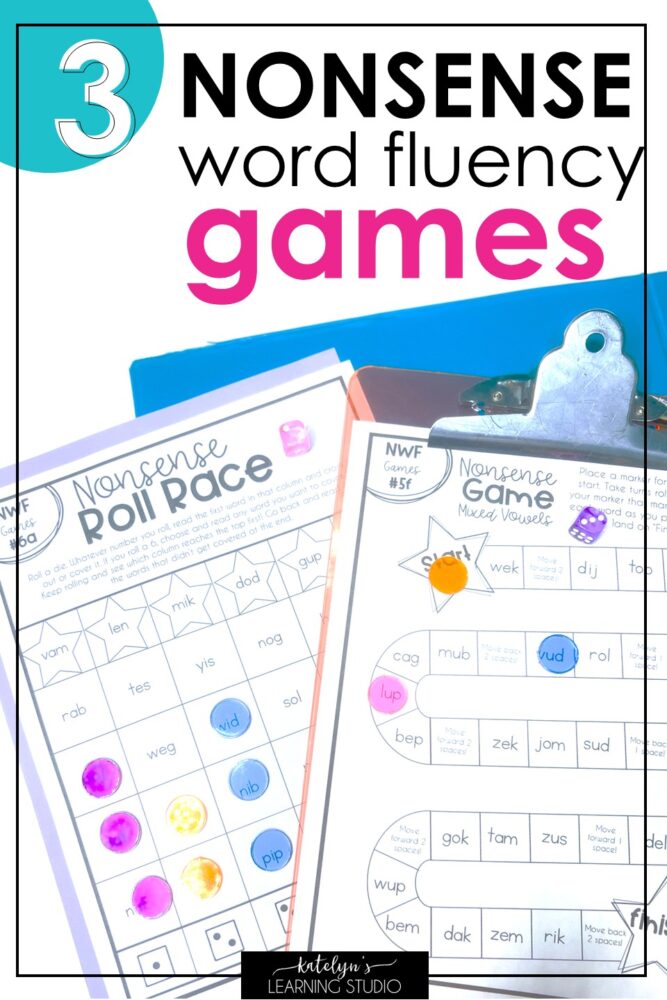
Game-based nonsense word fluency practice transforms boring drills into activities students actually BEG to do! The games in my NWF Binder work perfectly for literacy centers or small group intervention.
Activity 3: Game-Based Nonsense Word Fluency Practice
Let’s be honest, worksheet after worksheet of nonsense words can feel pretty mind-numbing for six-year-olds (and for us!). That’s why I’m a huge advocate for game-based practice.
Games transform decoding practice from a chore into something students actually look forward to. Plus, the repetition built into games helps build that crucial automaticity without feeling like drill-and-kill.
Some game formats that work beautifully for nonsense word practice:
Roll and read: Students roll a die and read that many nonsense words from a list
Board games: Move forward one space for each word read correctly (think Candyland-style paths)
Card games: Create “Go Fish” or “Memory” games using nonsense word cards
Partner games: Students take turns reading words to each other and keeping score
I’ve created a complete Nonsense Word Fluency Intervention Binder that includes dozens of ready-to-print games specifically designed for kindergarten and first-grade students. Teachers love it because it requires minimal prep. Just print, grab some dice or game pieces, and you’re ready to go for the entire year.
[Check out the complete NWF Intervention Binder here!]
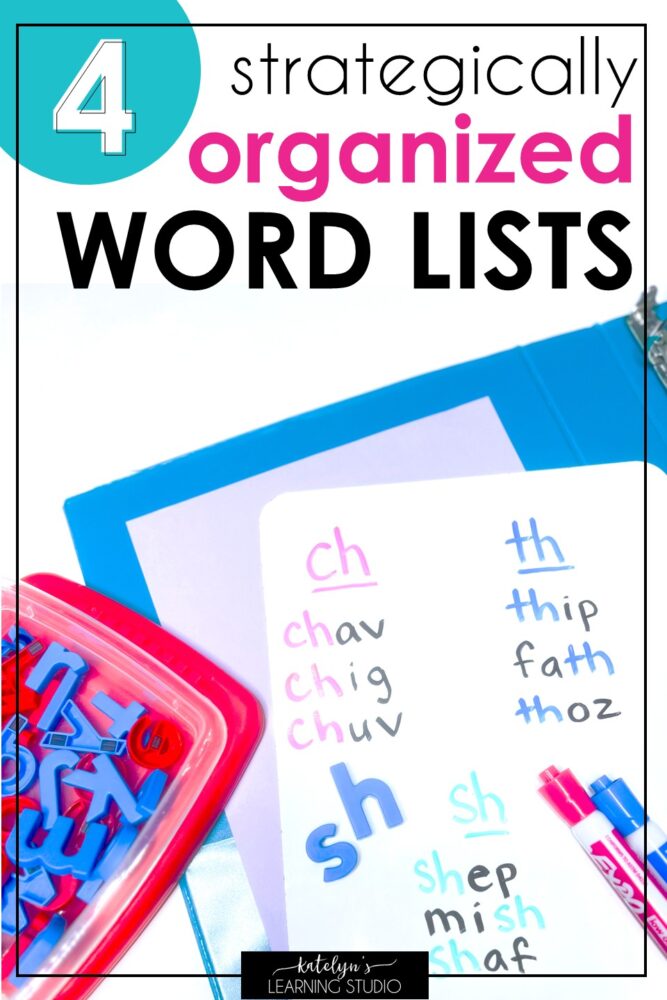
Strategically organized nonsense word lists that follow your phonics scope and sequence make practice more effective. Focus on one pattern at a time for maximum impact!
Activity 4: Strategically Organized Word Lists
Not all nonsense word fluency practice is created equal. Random lists of made-up words won’t be as effective as carefully sequenced practice that follows your phonics scope and sequence.
Here’s what effective nonsense word lists look like:
- They focus on one phonics pattern at a time (all CVC words with short /a/, for example)
- They gradually increase in complexity (VC → CVC → CCVC → CVCC → CCVCC)
- They include a mix of word-reading and sound-segmenting activities
- They spiral back to review previously taught patterns
When I’m planning nonsense word practice, I always ask myself: “What phonics skill are students currently learning?” Then I create or select nonsense words that provide targeted practice with that specific skill.
For example, if we just taught the /sh/ digraph, I’ll include nonsense words like “sheb,” “nish,” and “shup” in our practice activities. This helps students apply their new knowledge immediately and builds confidence.
Hint: You can download a free set of nonsense word task cards that are strategically set up to focus on specific phonics skills just like this. Keep reading to grab it! ⬇️
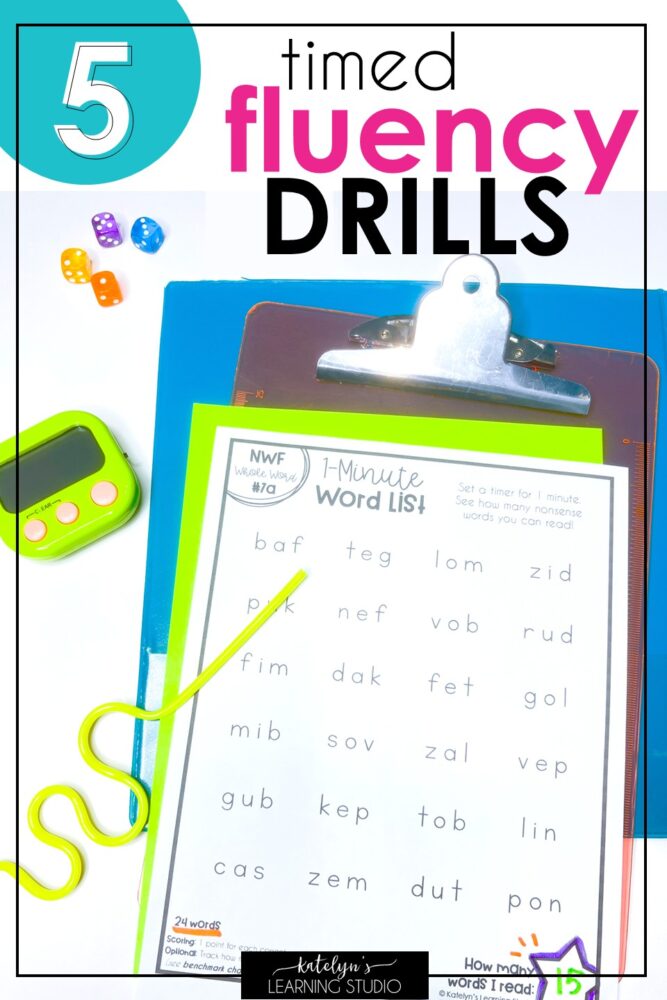
Timed nonsense word fluency drills like these prepare students for DIBELS assessments while building automaticity. Make it motivating by having students beat their own scores!
Activity 5: Timed Fluency Drills (DIBELS Practice)
Since DIBELS nonsense word fluency is a timed assessment, students benefit from practicing under similar conditions. But here’s the key: make it motivating, not stressful.
How to implement timed practice effectively:
Start with untimed practice until students feel confident with the word patterns
Introduce the timer gradually: “Let’s see how many you can read in 30 seconds!” (build up to one minute)
Focus on personal growth: Have students track their own progress and celebrate improvements
Use partner practice: Students time each other and offer encouragement
Keep it positive: Frame it as “beating your own score,” never as competition between students
My Nonsense Word Fluency Intervention Binder has tons of fun, kid-friendly formats for timed decoding drills. By making it feel like a game rather than a high-stakes test, students actually look forward to “beating their record.”
*For more ideas on increasing reading fluency, check out this post: 11 Reading Fluency Strategies that will Transform your Readers
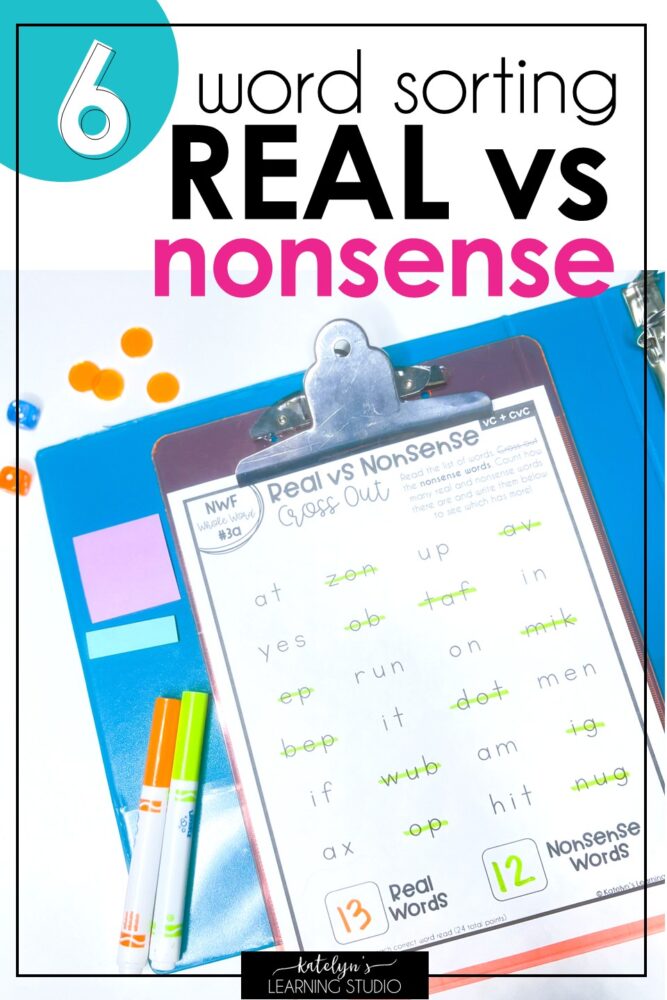
This real versus nonsense word sorting activity builds metacognitive awareness while reinforcing decoding skills.
Activity 6: Real vs. Nonsense Word Sorting
This activity builds metacognitive awareness while reinforcing nonsense word fluency skills. Students practice decoding while also developing their understanding of what makes a word “real.” This is the very beginnings of reading comprehension!
How it works:
- Provide a mixed list of real words and nonsense words (all following the same phonics pattern)
- Students read each word and decide: “Is this a real word or a nonsense word?”
- They sort the words into two columns
Example list (focusing on short /a/ CVC words):
- Real: cat, map, sad, tan
- Nonsense: taf, pam, nax, dap
This activity accomplishes two things: it gives students valuable nonsense word practice, AND it helps them understand that being able to decode a word doesn’t mean it’s automatically a real word. This distinction is important for reading comprehension development.
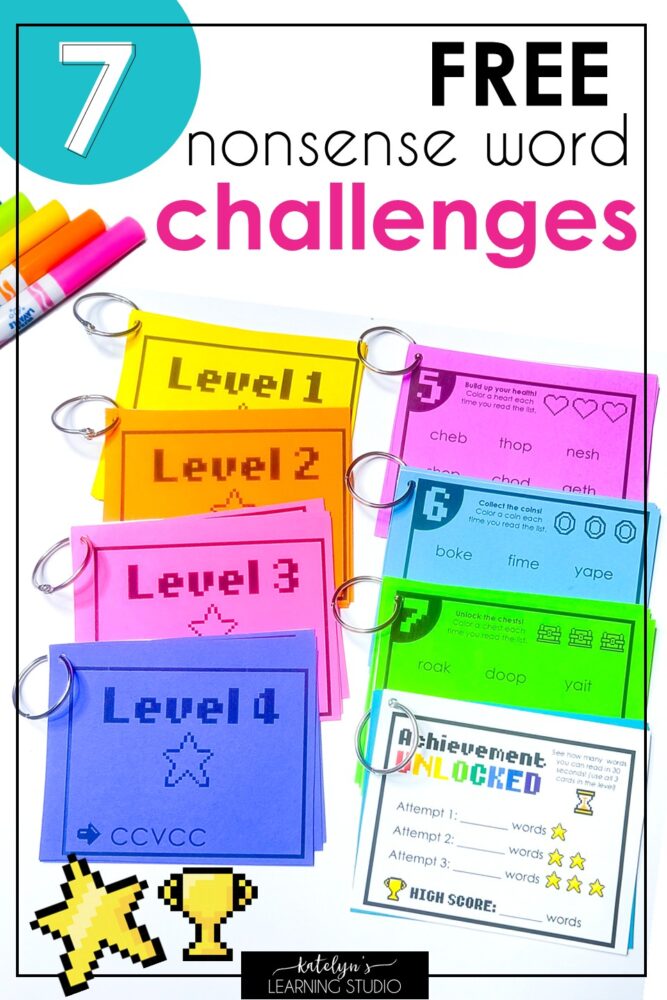
These FREE nonsense word fluency challenge cards use a video game theme with 8 progressive levels from VC words all the way to a multisyllabic Boss Level! Grab them here.
Activity 7: Progressive Nonsense Word Fluency Challenges
Once students have solid foundational skills, challenge them with progressively complex nonsense words that push their decoding abilities.
Progression pathway:
Level 1: CVC nonsense words (tob, nep, sig)
Level 2: CCVC nonsense words with blends (stob, plep, trig)
Level 3: CVCC nonsense words with blends (tobs, nept, sigs)
Level 4: CCVCC nonsense words (stobs, pleps, trigs)
Level 5: Nonsense words with digraphs (shob, chep, thig)
Level 6: Multi-syllabic nonsense words (tobbish, nepful, sigging)
Create “level up” charts where students can see their progress through these stages. When a student masters one level with 90% accuracy, they move to the next. This differentiation ensures that all students are appropriately challenged without feeling overwhelmed.
Or, you can download these free video game themed nonsense word task cards! 👇
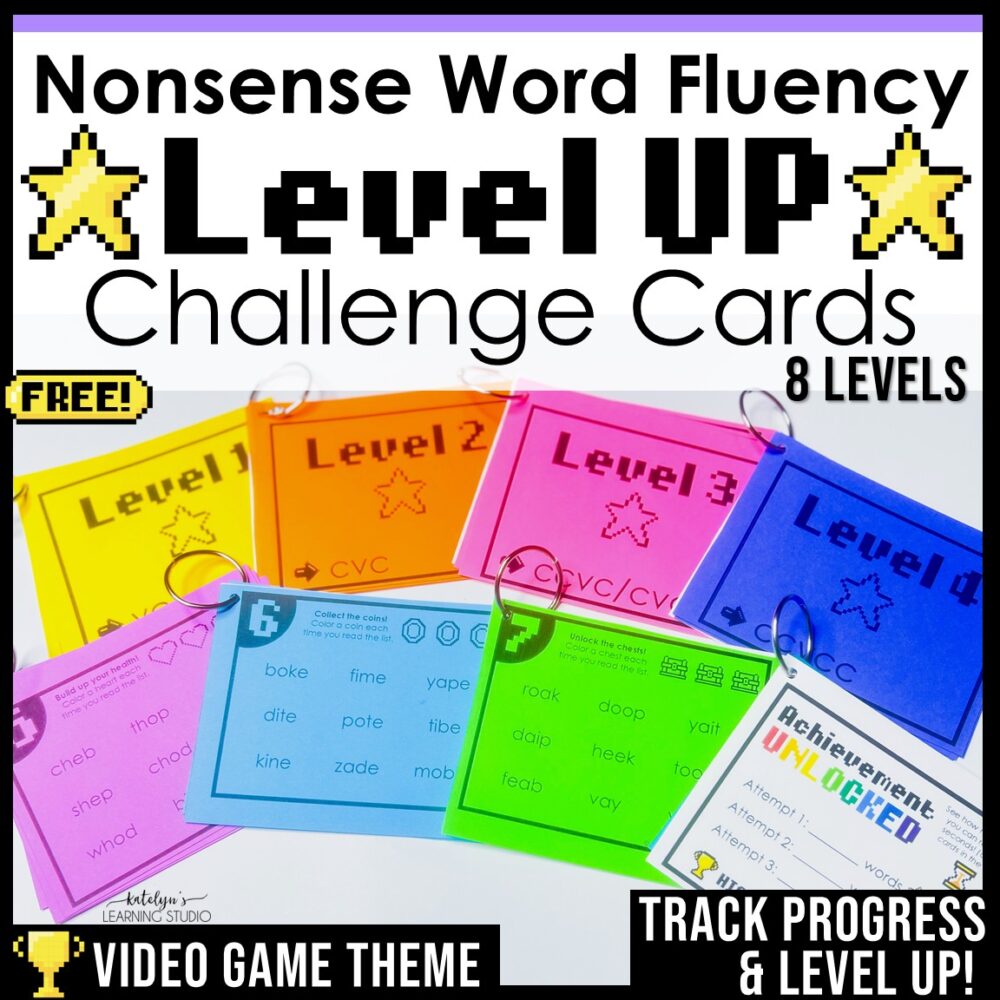
Download your FREE Nonsense Word Fluency Level Up Challenge Cards!
Totally print-and-go, this set includes 8 levels of targeted nonsense word lists, progress tracking cards, and a video game theme kids absolutely love! 🎮
- Level 1: VC words
- Level 2: CVC words
- Level 3: CCVC/CVCC
- Level 4: CCVCC
- Level 5: Digraphs
- Level 6: Silent e
- Level 7: Vowel teams
- 🏆 BOSS Level: Multisyllabic Words
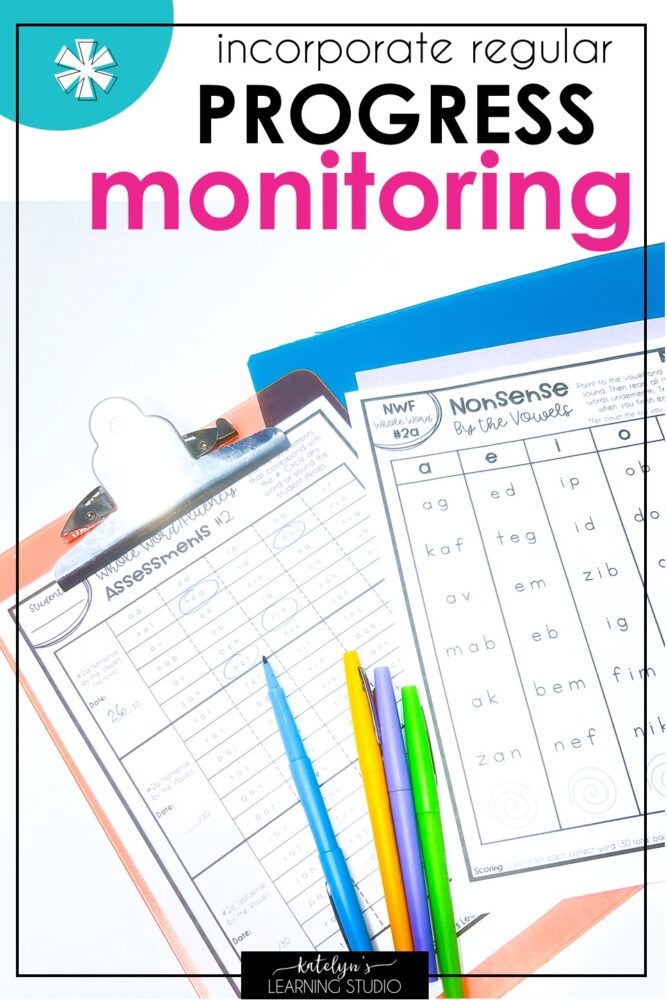
Regular progress monitoring helps you track nonsense word fluency growth, form intervention groups, and celebrate student success. All of my Reading Intervention Binders include detailed progress monitoring sheets for every activity.
Incorporating Regular Progress Monitoring
One of the most powerful aspects of nonsense word fluency practice is that it gives you clear, measurable data about students’ decoding skills.
I recommend assessing NWF at least once per month with students who are at risk or receiving intervention. For the rest of your class, quarterly assessments work well.
What to track:
- Words read correctly per minute (WCPM) for DIBELS alignment
- Accuracy percentage
- Specific error patterns (do they struggle with blends? Vowels? Ending sounds?)
Use this data to:
- Form flexible intervention groups
- Adjust your phonics instruction
- Celebrate growth with students and families
- Determine when students are ready to move on to more complex patterns
When students can see their own progress (even on a simple chart or graph) it builds motivation and helps them understand that their hard work is paying off.
Your Nonsense Word Fluency Implementation Plan
Ready to start using nonsense word fluency activities in your classroom? Here’s a simple timeline to get you started:
Weeks 1-2: Introduce the concept of nonsense words during whole-group phonics instruction. Model blending with simple CVC nonsense words.
Weeks 3-4: Begin incorporating short (2-3 minute) nonsense word practice into your daily phonics routine. Use word lists that align with your current phonics focus.
Week 5+: Add game-based practice during small group time or centers. Start monthly progress monitoring with at-risk students.
Throughout the year: Continue spiraling back to nonsense words as you introduce new phonics patterns. Adjust difficulty based on student data.
Remember, consistency matters more than duration. Five minutes of focused nonsense word fluency practice three times per week will yield better results than one 20-minute session per week.
Your Complete Nonsense Word Fluency Solution
You’ve just learned 7 powerful strategies for teaching nonsense word fluency. Now imagine having all the materials to implement them already created, organized, and ready to use.
That’s exactly what my Nonsense Word Fluency Intervention Binder gives you:
✨ 30+ Print-and-Go Games
No more spending nights creating materials. Just print, laminate (optional), and play!
✨ Organized by Phonics Pattern
CVC, blends, digraphs, vowel teams, silent e, multisyllabic (it’s all there and sequenced for you!)
✨ Progress Monitoring Made Easy
Track student growth with included assessments and data sheets. Perfect for RTI documentation!
✨ Differentiation Built In
Meet every student where they are with leveled activities and word lists.
✨ Science of Reading Aligned
Every activity supports structured literacy principles and systematic phonics instruction.
The best part? Teachers say this binder has saved them 10+ hours of planning while their students’ DIBELS scores improve. That’s time you get back for what matters most (actually teaching)!
👉 Get your Nonsense Word Fluency Intervention Binder here!
Whether you use my resources or create your own, I hope this guide has given you the confidence and tools to make nonsense word fluency practice effective and FUN for your students!
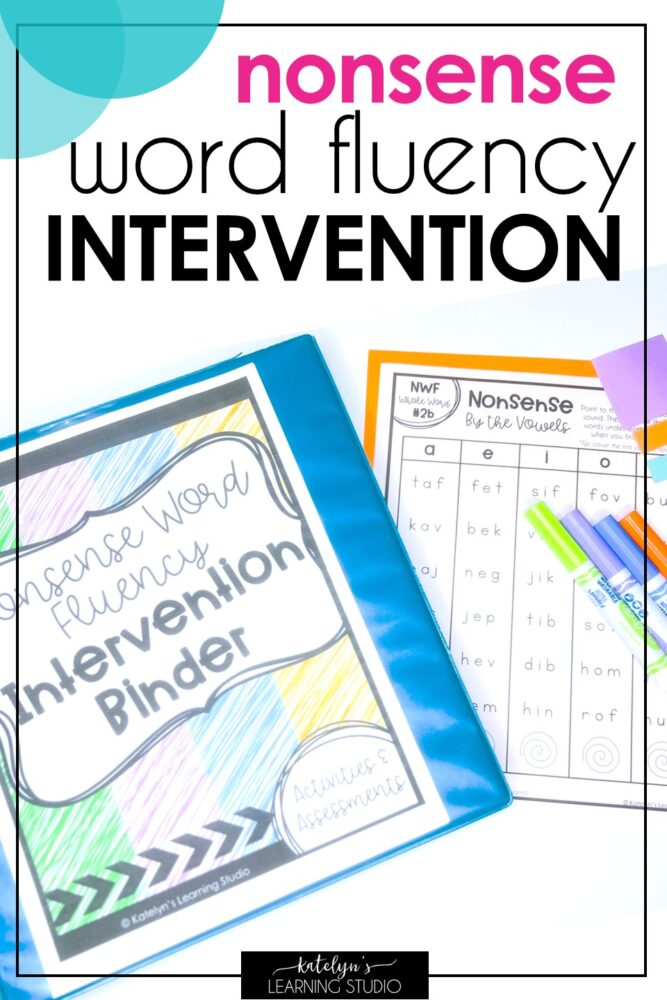
Want even MORE nonsense word fluency activities? My complete Nonsense Word Intervention Binder includes games, assessments, word lists, and progress monitoring tools—perfect for DIBELS prep!
Nonsense word fluency might seem like a strange concept at first, but it’s truly one of the most valuable tools in your early literacy toolkit. When students can decode nonsense words with confidence, you know they’ve developed genuine phonics skills— not just a good memory for sight words.
By using explicit instruction, multi-sensory techniques, engaging games, strategic word lists, timed practice, sorting activities, and progressive challenges, you’ll help your students build the strong decoding foundation they need to become confident, capable readers and you’ll see their DIBELS scores improve along the way.
At the end of the day, we’re not just teaching kids to read nonsense words. We’re giving them the skills to read everything.
Ready to transform your nonsense word fluency instruction?
👉 [Grab the Nonsense Word Fluency Intervention Binder]
💌 [Subscribe below to get weekly tips, free resources, and classroom-tested activities delivered straight to your inbox.]
💚 [Check out my TPT store for more phonics and reading intervention resources that make teaching easier!]
Happy teaching!